Understanding the Pythagorean Theorem Through Area
Understanding the Pythagorean Theorem Through Area
The Pythagorean theorem is one of the most famous and widely known theorems in mathematics. It's a fundamental principle that states in a right-angled triangle, the square of the length of the hypotenuse is equal to the sum of the squares of the lengths of the other two sides. This can be written as:
a^2+b^2=c^2
The Significance of Area in the Pythagorean Theorem
The Significance of Area in the Pythagorean Theorem
One of the intuitive proofs of the Pythagorean theorem involves understanding the areas of squares constructed on each side of the right-angled triangle. By using areas, we can visualize and grasp why the theorem holds true.
Visualizing the Proof with Squares
Visualizing the Proof with Squares
Consider a right-angled triangle with sides a, b, and hypotenuse c. We can construct squares on each of these sides, and the area of each square will be a^2, b^2, and c^2 respectively.
To understand the theorem using these areas, follow these steps:
1. Construct the Larger Square:
1. Construct the Larger Square:
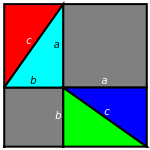
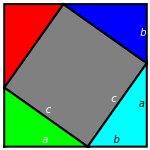
Draw a large square with side length a + b. The area of this square is (a + b)^2.
2. Break Down the Larger Square:
2. Break Down the Larger Square:
Inside this large square, place the right-angled triangle in such a way that you form four congruent triangles and a smaller square with side length c.
3. Calculate the Area of the Large Square:
3. Calculate the Area of the Large Square:
The area of the large square is (a + b)^2.
In[]:=
Expand[(a+b)^2]
Out[]=
2
a
2
b
4. Calculate the Area Using Triangles and the Smaller Square:
4. Calculate the Area Using Triangles and the Smaller Square:
The area of the large square can also be calculated by summing the areas of the four triangles and the smaller square. The area of one triangle is 1/2 ab. So, the total area of the four triangles is 4 × 1/2 ab = 2 ab. The area of the smaller square is c^2.
5. Equate the Two Areas:
5. Equate the Two Areas:
From the two methods of calculating the area of the large square, we get:
2
a
2
b
6. Simplify to Prove the Theorem:
6. Simplify to Prove the Theorem:
Subtracting 2ab from both sides, we obtain:
a^2+b^2=c^2
This visual proof not only confirms the Pythagorean theorem but also provides an intuitive understanding of why it holds true.
Additional Insights
Additional Insights
The Pythagorean theorem has numerous proofs, ranging from geometric to algebraic to even those involving calculus. An interesting historical note is that a US president, James Garfield, is known to have provided a proof of the theorem.
Sid Venkatraman
“Three Proofs of the Pythagorean Theorem”
http://demonstrations.wolfram.com/ThreeProofsOfThePythagoreanTheorem/
Wolfram Demonstrations Project
Published: August 7 2012
“Three Proofs of the Pythagorean Theorem”
http://demonstrations.wolfram.com/ThreeProofsOfThePythagoreanTheorem/
Wolfram Demonstrations Project
Published: August 7 2012
|  | ||||||||||||||||||||||||||||||||||||||
|