Wasserstein Stability and Topology of Signals and Their Distributions
BSU Mathematics Seminar • Optimal Transport in Signal Processing and Data Science
- When
-
Monday, March 2, 2026
• 3:00 pm – 4:00 pm (ET) - Where
-
Zoom (remote): https://bridgew.zoom.us/j/91678321797
Meeting ID: 916 7832 1797 - Speaker
- Dongwei Chen (Colorado State University)
- Format
- Remote talk via Zoom
- Organizers
-
Vignon Oussa (VOUSSA@bridgew.edu) •
Xiangfei “Fei” Chen (X10CHEN@bridgew.edu) •
Mahmoud El-Hashash (MELHASHASH@bridgew.edu)
Please use the “Join via Zoom” button above (or the link in the “Where” field). If Zoom prompts for authentication,
sign in with your BSU account or contact an organizer.
Abstract
In this talk, we will discuss how optimal transport can be used to quantify the stability of complex systems,
including signal processing systems, climate systems, and solar power systems. Many systems in science and
engineering are naturally modeled by probability distributions rather than deterministic quantities. Traditional
stability analysis often focuses on mean behavior, but the mean alone is not enough to capture structural changes
in distributions, such as extreme events.
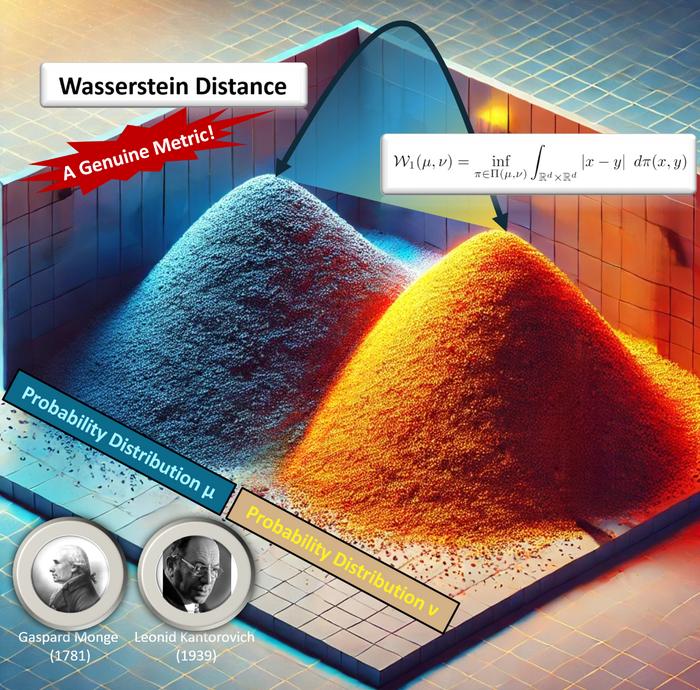
To address this, we will introduce the Wasserstein distance, a metric on the space of probability measures,
and demonstrate how it provides a unified framework for quantifying stability across disciplines.
On the theoretical side, we will first present recent stability and topological results on probabilistic frames
in signal processing, where frame systems are lifted to probability measures. Using the 2-Wasserstein metric,
we establish openness, stability, and topological properties of probabilistic frames and their duals, and show how
optimal transport enables the comparison of frames with different cardinalities.
On the applied side, we will discuss stability analysis for climate systems and solar power, where distributional
changes can be detected by Wasserstein distance even when mean values remain nearly unchanged. These examples
illustrate how optimal transport provides new mathematical tools for understanding variability and extreme events
in climate and environmental data.
Overall, this talk aims to build a bridge between harmonic analysis, optimal transport, and domain science,
highlighting how mathematical foundations can advance practical problems in signal processing, climate science,
and renewable energy.
Short Bio
Dongwei Chen is a Rocky Mountain Postdoctoral Fellow in the Department of Mathematics at
Colorado State University. His research lies at the intersection of analysis, probability, and data science,
with a particular focus on optimal transport and probabilistic frame theory, alongside applications in renewable
energy, atmospheric turbulence, and climate stability analysis.
He earned his Ph.D. in Mathematics from Clemson University. His postdoctoral mentors are Clayton Shonkwiler
and Emily King, and his Ph.D. advisor was Martin Schmoll.
Links:
Zoom room
•
Speaker homepage
Questions? Contact an organizer:
Vignon Oussa,
Xiangfei (Fei) Chen,
Mahmoud El-Hashash.